Real Estate News · October 28, 2026
The Bank of Canada Just Raised Rates to 2.50%: What It Means for Calgary Buyers and Sellers
The Bank of Canada raised its policy rate a quarter point to 2.50% on October 28, the first hike since 2023. Here's why it happened and what it actually means for buying or selling in Calgary right now.
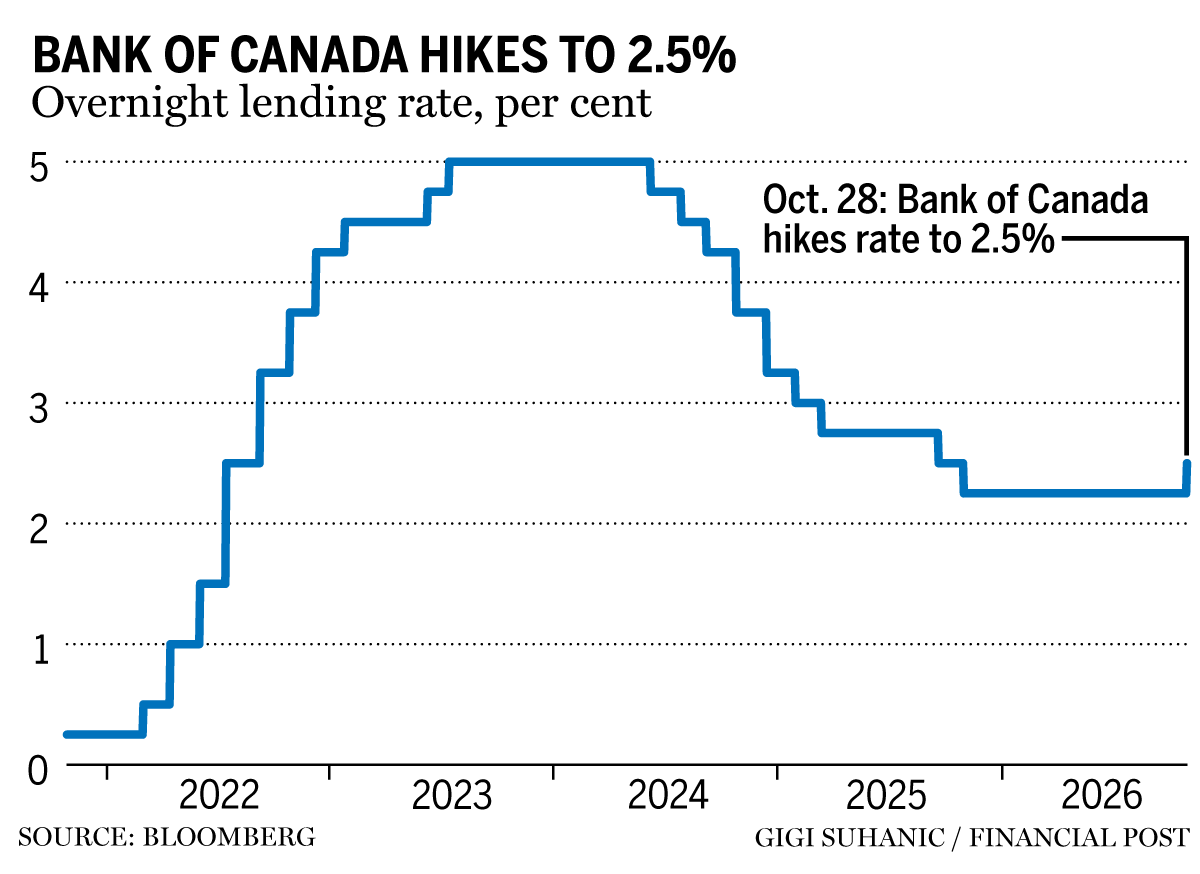
The Bank of Canada raised its policy rate on October 28, and I've already had a handful of people ask me about it — some assuming it was a government decision, which it wasn't. The Bank of Canada is Canada's central bank, separate from the federal government, and this is its call to make, not Ottawa's. I think that distinction actually matters here, because the reasoning behind it is almost entirely about energy prices and inflation, not politics. Here's what actually happened and what it does and doesn't change if you're buying or selling in Calgary.
What exactly changed?
The Bank raised its overnight target rate by a quarter point, from 2.25% to 2.50%. That's the first increase since July 2023 — before that, it had held steady through six straight decisions this year. Banks matched it within a day: RBC, TD, CIBC, and BMO all moved their prime lending rate from 4.45% to 4.70%, effective October 29.
Why did they raise it now?
Short version: inflation came in hotter than the Bank expected back in July, and most of that is energy-driven. CPI has been running around 3% since the spring and the Bank now expects it near 3.5% by year-end — well above its 2% target. Strip out gas prices and it's a more modest 2.2%, but the Bank's own language was blunt about the cause: an ongoing Middle East conflict, now in its eighth month, has kept oil elevated, with Brent crude averaging close to $125 a barrel in October, roughly $35 higher than in July. Governor Macklem put it directly — the hike was needed "to reduce the risk that elevated energy prices could spill over" into broader prices, especially with survey data showing 60% of consumer-facing businesses planning to pass rising costs on to customers within the next year.
It's not purely an inflation story, either. The economy's been running hotter than forecast — GDP grew 3.3% in the second quarter, and unemployment has sat around 6.5% for months. That combination of decent growth plus persistent inflation is exactly the setup that pushes a central bank toward raising rates rather than holding or cutting. The Bank was also direct that this isn't necessarily the last move: it said the rate "could need to rise further," though it plans to "proceed carefully" given how much hinges on the Middle East situation and the US-Canada trade relationship. The next decision is December 9.
What does this mean if you're buying?
It depends almost entirely on what kind of mortgage you're looking at. If you're planning to go fixed, the direct impact is small — fixed rates track government bond yields, not the Bank's overnight rate, and a lot of this move was already priced in before it happened. Several lenders had nudged fixed rates up slightly back in September in anticipation. If you're considering a variable-rate mortgage, the effect is immediate: on a $500,000 balance with 25 years left, a quarter-point increase adds somewhere in the $65–$70 range to your monthly payment. If you already have a variable mortgage with a fixed payment amount, your payment might not move, but more of it is now going to interest and less to principal — worth checking your statement rather than assuming nothing changed.
On the affordability math for a new purchase, this is a marginal tightening, not a dramatic one. A quarter point on a mortgage rate shaves a modest amount off what a lender will qualify you for. It's real, but it's not the kind of shift that should by itself change whether this is a good time to buy — the bigger variables are still your own price range, the property type, and which part of the city you're looking at.
What does this mean if you're selling?
It's one more small headwind layered onto a market that was already balanced to soft, not a new story on its own. Calgary's September numbers — the most current CREB release as of this week — show 1,650 sales, down 3.8% year over year, with the overall benchmark price at $566,700, down 0.8%. That breaks down unevenly: detached sat at $739,400, down just 1%, while apartment-style condos were down 8.3% to $291,400, and row-style homes fell 5.5%. New listings were down 11.3% to 3,354, and total inventory sat at 6,486, down 6.3% — roughly four months of supply citywide, which CREB considers balanced.
A rate hike doesn't flip that picture overnight, but it does nudge demand at the margin in the direction it was already leaning — a bit softer for the segments that were already softer. If you're selling a detached home in a tighter sub-market, this barely registers. If you're selling a condo in a part of town competing against a lot of other listings, it's one more reason buyers might hesitate or negotiate harder, on top of a trend that was already there before October 28.
Which markets actually feel this?
Every market in Canada faces the same rate — it's a national number — but the bite isn't equal. It hits hardest wherever prices are highest relative to income, because the same quarter-point costs a lot more in dollar terms on a $1.3 million Toronto or Vancouver mortgage than on a $566,700 Calgary one. It also hits variable-rate and HELOC holders immediately, while fixed-rate holders mostly won't feel anything until they renew. Calgary's relative price advantage and comparatively resilient job market and population growth are real buffers here — they don't make the city immune, but they're a meaningful reason this market tends to absorb rate moves better than the priciest coastal markets do.
If you're trying to figure out what any of this actually means for your specific plans — whether that's timing a purchase around a variable vs. fixed decision, or pricing a listing with this now baked into buyer psychology — that's exactly the kind of conversation worth having before you make a move, not after.
More insights
Selling
Is Now a Bad Time to Sell a Calgary Condo?
Calgary's condo benchmark price is down 8.3% year over year and inventory keeps climbing — here's what's actually behind the slide and how to price yours realistically if you're thinking about listing this fall.
Selling
What "Not a Single Home Sold Above Asking" Means for Your Listing Price
Calgary's underbidding stats sound scary, but the real story is that the discount varies hugely by price band and property type — here's what that means for how you should actually price your listing.
Buying
Buying in a Calgary Market With No Bidding Wars
Calgary's sale-to-list ratio has slipped to 97.4% and homes are taking 44 days to sell on average, so this is a negotiation market, not a bidding-war market. Here's how to actually use that leverage when you're the one writing the offer.

Tell me what your next move looks like.
Whether you are searching for the right Calgary home, planning a move from another province or preparing a property for market, we can start with a straightforward conversation.